Over the last few months, we have consistently saved around 40% on our grocery bill every single month.
And no, it is not because we suddenly became amazing coupon people. We did not find a magical new grocery store. We did not switch to eating only rice and beans. We did not stop buying good food.
We simply changed the way we organize our kitchen, pantry, fridge, freezer, and grocery shopping routine.
For a family of four—two adults and two small children—our grocery spending used to be around $1,000 per month. Some months were a little lower, some months were higher, especially when we stocked up on basics like olive oil or other expensive household staples.
Now, we usually spend around $600 per month.
That is a difference of roughly $400 every month. Over a year, that can add up to nearly $5,000—money that can go toward debt repayment, savings, investing, emergency funds, travel, home projects, or simply more breathing room in your budget.
For us, this is what frugal living looks like in real life. It is not about never buying anything. It is about building simple systems that make your money go further without making daily family life harder.
Grocery prices have become expensive almost everywhere. We live in South Carolina, and while people often say that groceries here are relatively affordable compared to other parts of the United States, it does not always feel that way when you are feeding a family. Grocery costs can vary widely depending on where you live, what your family eats, whether you have young children, and how often you shop.
But one thing is true almost everywhere: A lot of money is lost through food waste, duplicate purchases, forgotten pantry items, and unplanned grocery shopping.
The good news is that you do not need a complicated budget spreadsheet, an enormous stockpile, or an extreme no-spend challenge to change that. You can start with the food you already own.
These are the five organization rules that made the biggest difference for our family. Some of them sound almost too easy to work, but they have helped us shop more intentionally, waste much less food, and feel far less stressed in our kitchen.
If you are interested in homesteading, pantry organization, simple living, financial freedom, or reducing your grocery budget without living on deprivation meals, these ideas may help you too.
Why Kitchen Organization Can Save So Much Money
When people think about lowering their grocery budget, they often immediately think about shopping strategies.
They look for coupons. They download store apps. They chase sales. They compare prices between several stores. Those things can help, of course. But they are not always the first place to start.
Before buying anything else, it helps to know what is already in your home.
A disorganized fridge can make perfectly good food invisible. An overflowing freezer can hide expensive ingredients until they are freezer-burned. A pantry full of duplicates can create the feeling that you have nothing to eat—even when you have enough food for many meals.
That was a big realization for us.
Our problem was not always that we bought too little or that we needed more variety. Often, our problem was that we did not use what we had. We would buy groceries with good intentions, put them away quickly, forget about them, and then buy similar things again the next week.
This is where food waste and financial freedom connect.
Every item that expires in the fridge is money that was already spent. Every duplicate item sitting behind three other duplicate items represents money that could have stayed in your bank account. Every rushed grocery trip without a clear overview makes it easier to buy based on fear, convenience, or habit instead of actual need.
A well-organized kitchen is not about having a Pinterest-perfect pantry. It is about making your food visible, accessible, and easy to use.
The following five rules gave us exactly that.
Rule 1: Create a “Use Me First” Zone
This first rule sounds basic, but it is the foundation for almost everything that comes after it.
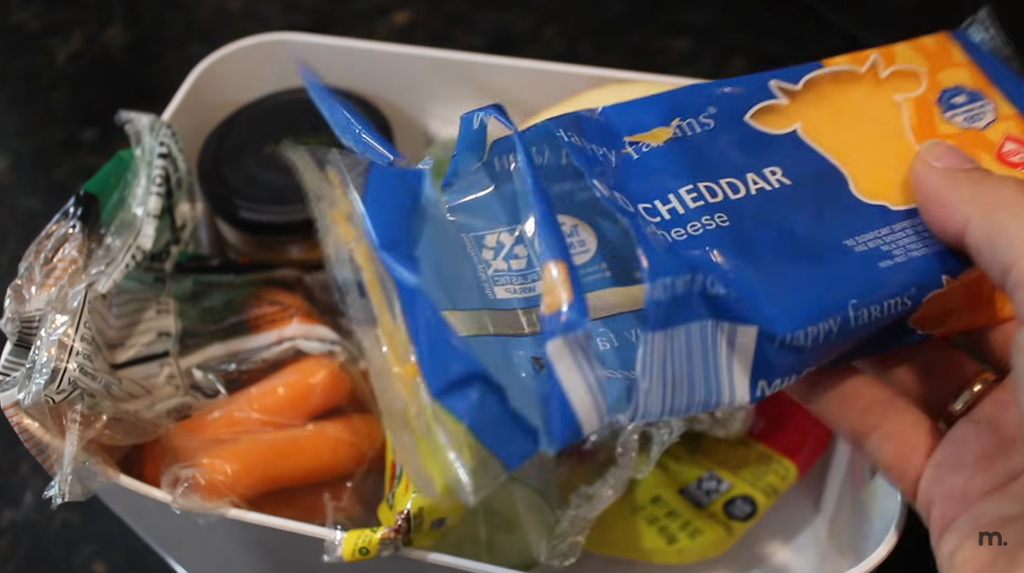
Create one specific place for food that needs to be eaten soon.
You can use a basket in your fridge, a bin in your pantry, or one designated shelf in your freezer. The location does not matter as much as the habit. The point is that anything that should be used first has one obvious home.
This might include:
- Opened packages.
- Leftovers.
- Produce that is starting to look a little tired.
- Items close to their expiration date.
- Food you bought for a recipe but did not end up making.
- Ingredients that have been in the pantry for too long.
- Half-used jars, sauces, spreads, or baking ingredients.
- Freezer items you keep meaning to use.
Everything goes into the “use me first” zone and nowhere else.
When it is time to make dinner, start there. Before you look at recipes, before you think about going to the store, before you decide that there is “nothing to eat,” take a look in that basket, bin, or shelf.
Ask yourself a few simple questions:
- What needs to be used today or tomorrow?
- What can I turn into a meal?
- Can I add this ingredient to something we already planned?
- Can this become lunch, a snack, a side dish, or part of breakfast?
- Is there something here that I should freeze before it goes bad?
This system is not complicated. It takes maybe five minutes to set up. But it makes food impossible to ignore.
Before using this method, we often had ingredients that disappeared into the back of the fridge. A container of leftovers would be placed behind a few bottles. Half a package of cheese would get buried under fresh produce. A vegetable would sit in the drawer until it was too late.
Now, food that needs attention is in one visible place.
That one change can dramatically reduce food waste. And throwing away food is literally throwing away money.
The Second Part of the “Use Me First” Rule
There is another habit that goes along with this, and honestly, I do not know many people who naturally do it this way.
When most people come home from grocery shopping, they put the new food in front. The older food gets pushed farther back into the fridge, pantry, or freezer. It is understandable—we are tired, we want to put everything away quickly, and the easiest option is to place the new item wherever there is space.
But that system makes older food disappear.
Try doing it the other way around.
When you are unpacking groceries, take the older items out first if necessary. Put the new items behind them. Then return the older items to the front.
This is a very simple version of the “first in, first out” system used in restaurants and food storage. The foods that were already in your home remain visible and accessible. The new items stay behind them until it is their turn.
You do not have to make it perfect. You do not need labels on every shelf. Just make an effort to keep older food in front.
It can feel a little inconvenient at first, but it becomes automatic surprisingly quickly. And the payoff is that you stop finding forgotten food weeks later.
For people interested in homesteading or a more self-sufficient lifestyle, this is especially useful. Whether you are storing garden produce, canned goods, bulk grains, homemade freezer meals, or regular grocery-store food, rotation matters. Food storage only saves money when you actually use what you store.
The “use me first” zone helps you make food rotation part of normal daily life.
Rule 2: Use the “One Backup Only” Rule
The next rule was a huge change for our grocery shopping habits.
The rule is simple: For every regular item, we only allow one backup.
That means one item in use and one replacement item behind it.
Not four bottles of ketchup in the fridge. Not five packages of flour in the pantry. Not a whole shelf of tomato paste, cereal, canned corn, cooking oil, pasta, or snacks that we forgot we already owned.
Just one backup.
I know this can sound restrictive, especially if you are used to stocking up. But it is not about never having enough food. It is about having enough without creating chaos.
In our family, this was especially helpful during grocery shopping. I do not know why this happens, but my husband would sometimes go shopping after I told him that we still had plenty of something at home.
“Please do not buy corn,” I would say. “We have four cans in the pantry.”
And somehow, corn would still come home.
I know many families have a version of this story. One person thinks there is no more ketchup, another person buys more coffee, someone sees a sale on pasta, and suddenly the pantry is full of five versions of the same thing.
The one-backup rule eliminates a lot of that.
Before buying something, ask: Do we have one currently open or in use? Do we also already have one unopened backup?
If the answer is yes, do not buy more.
Why This Rule Works
The smaller buffer may feel uncomfortable at first. You may worry that you will run out of your favorite food. But in reality, most of us have much more food at home than we think.
The one-backup rule changed three important things for us.
First, we bought fewer duplicates.
This sounds obvious, but it made an immediate difference. When we stopped buying extras “just in case,” we suddenly had more space in the cabinets. More space made it easier to see what was actually there.
Second, food stopped magically disappearing in the pantry.
Before, things would get lost behind duplicates. We would buy a new bag of flour because we thought we were out, only to find another unopened bag later. With less clutter, every item became visible.
Third, it supported the “use me first” system. When less food comes into the house unnecessarily, it becomes easier to use what is already there before it expires.
This rule also helped us challenge the fear of not having enough.
There is a difference between thoughtful food storage and accidental overbuying. A homesteading pantry or emergency pantry can absolutely be useful, especially if you live far from stores, preserve your own food, buy staples in bulk, or want more resilience in your household.
But many people do not have an intentional stockpile. They simply have random duplicates spread across cupboards.
That is not necessarily preparedness. Often, it is just expensive clutter.
Having one backup of everyday items still means you are prepared. You can finish your current bottle of oil and have another one ready. You can use the last bag of rice and know there is one more in the pantry. You are not creating scarcity. You are creating awareness.
And awareness is a major part of frugal living.
Rule 3: Organize Your Pantry by Zones Instead of Categories
This rule was probably the biggest mindset shift for me.
I was 33 years old before I seriously considered that I did not have to organize my pantry the way everyone else seems to organize a pantry.
Most people organize by category.
All canned goods go together. All spices go together. All baking ingredients go together. All vegetables go together. All grains go together.
That makes logical sense when you are looking at a pantry from the outside. But it is not necessarily how we use food in real life.
When I make breakfast, I do not use one food category. I might need oats, flaxseed, protein powder, nut butter, cinnamon, and maybe dried fruit. If all of those things are stored in completely different areas, I have to go back and forth across the pantry every morning.
The same is true when cooking dinner. I may need oil, spices, canned tomatoes, pasta, beans, broth, and vegetables. If everything is organized only by category, I spend more time searching, moving around, and forgetting what I was looking for.
So instead of organizing only by categories, I started organizing by zones.
Our pantry now has:
- A breakfast zone.
- A cooking and dinner zone.
- A baking zone.
- A snack zone.
- A grain zone.
The breakfast zone contains the things we reach for in the morning. Oats, flaxseed, protein powder, breakfast toppings, and similar staples all live together.
The cooking zone holds ingredients we use frequently for dinners, casseroles, sauces, and everyday meals. It includes spices and foods that do not belong in the breakfast zone.
The baking zone contains flour, baking powder, sugar, chocolate chips, vanilla, and ingredients that are mostly used for baking.
The snack zone is for snacks, lunchbox items, crackers, dried fruit, and easy grab-and-go foods.
The grain zone holds items like rice, pasta, quinoa, couscous, and other staples we use in different meals.
Of course, some ingredients could fit into more than one zone. Oats can be used for baking, for example. But in our family, oats are mainly a breakfast staple, so they belong in the breakfast zone.
The goal is not to create the perfect pantry system. The goal is to store items where you use them most often.
Why Pantry Zones Save Money
This method changed how we use our available groceries.
When ingredients that belong together are stored together, it is easier to see meals instead of random food items. Looking at the breakfast zone, I can quickly see whether we have enough for the week. Looking at the cooking zone, I can see whether we have ingredients for a few dinners.
It becomes easier to notice what is missing before you go shopping.
For example, when the breakfast zone is running low, you immediately know what should go on the grocery list. You do not need to search every shelf, open every container, and make mental notes.
It also reduces the chances of duplicate shopping. If you can clearly see that you still have oats, you are less likely to buy another bag out of habit.
For a family trying to live more simply, this can be a surprisingly calming change. Kitchen organization does not need to look beautiful for social media. It needs to make everyday life easier.
Your pantry should work for you, not make you work harder.
If you are building a homestead pantry, a minimalist pantry, a family pantry, or simply trying to spend less at the grocery store, organizing by use zones can make your food more practical and visible.
Rule 4: Do a 30-Second Inventory Before Grocery Shopping
This rule is extremely simple, free, and effective.
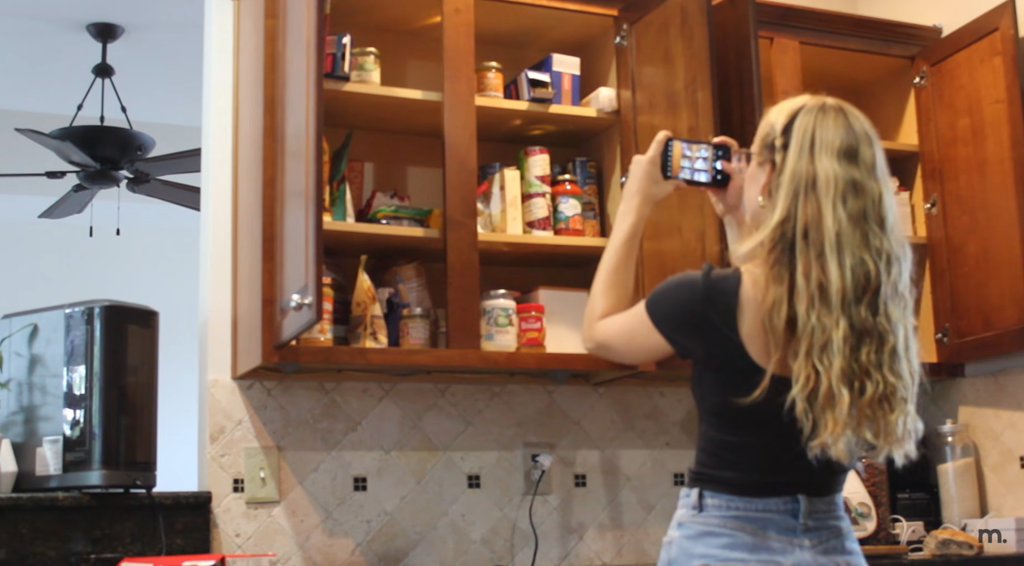
Before leaving the house to go grocery shopping, take out your phone and take quick pictures of your pantry, fridge, freezer, and even your spice shelf.
That is it.
It takes about 30 seconds.
Most people have had the experience of checking the pantry before going to the store, then arriving at the store and completely forgetting what they saw. You may know that you looked at the fridge, but you cannot remember whether you had one carton of eggs left or two. You may think you are out of pasta, then come home and discover pasta in the back of a cabinet.
A photo does not have to show every tiny label perfectly. The purpose is not to create a detailed inventory from the image. The photo simply helps you remember what your kitchen looked like.
If you are standing in the grocery store wondering whether you need more canned beans, olive oil, frozen vegetables, flour, spices, or snacks, you can check your phone.
This tiny habit can prevent a lot of unnecessary purchases.
It is also helpful if more than one person in the household does the grocery shopping. You can share the photos with your partner before they leave. Instead of trying to explain the current state of the pantry through text messages, they can quickly see what is available.
Taking the System Further With a Pantry Tracker
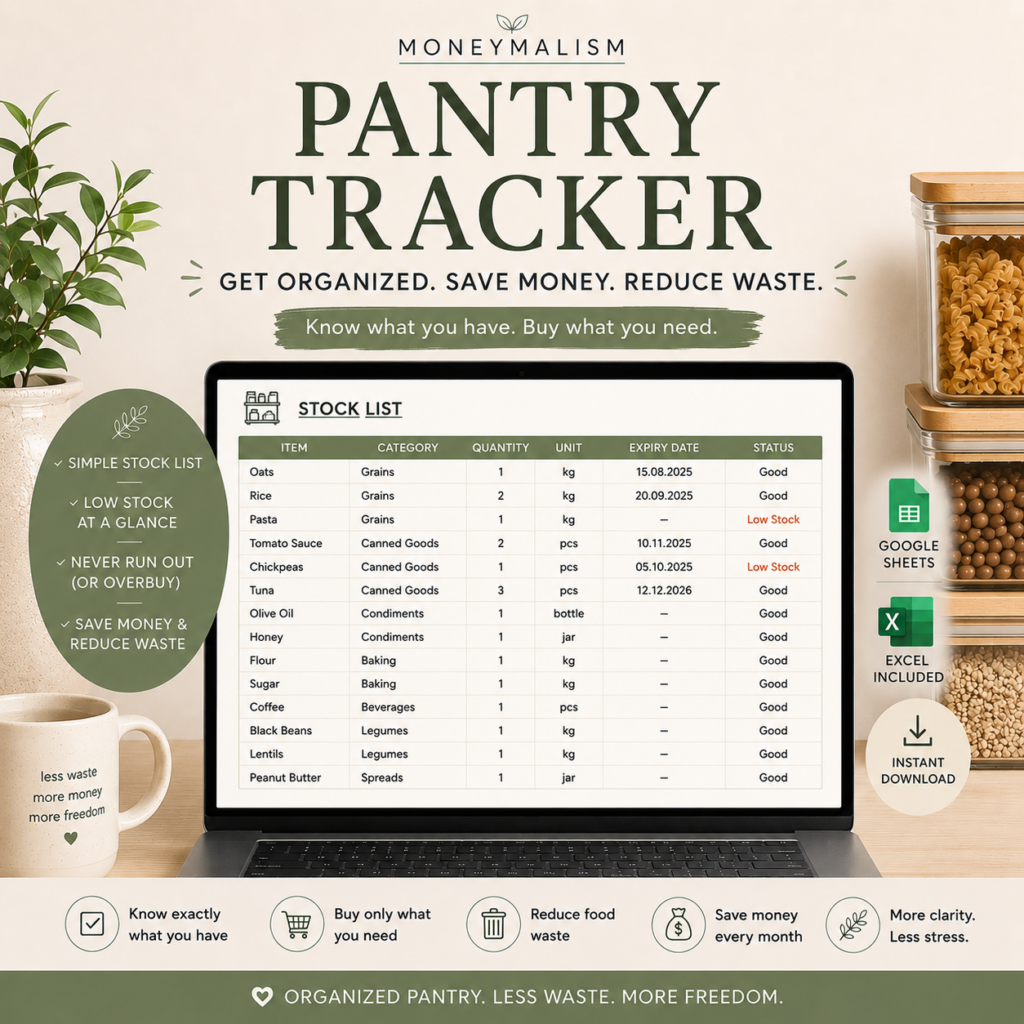
Taking photos is the easiest version of an inventory system. But if you want something more detailed, a pantry tracker can be incredibly helpful.
I created a simple Excel spreadsheet because I am a little bit of an Excel nerd.
The pantry tracker is not complicated. You can make one with a basic spreadsheet and access it from your laptop or phone. You can also share it with your partner, which makes grocery shopping and meal planning easier for everyone.
When I first started, I did a full inventory of our pantry, fridge, and freezer. I entered what we had into the tracker. After that, I only needed to update it regularly—usually once per week.
The tracker does two useful things.
First, it shows what we still have in stock.
Before grocery shopping, I can open it on my phone and check our available ingredients. This makes it easier to avoid duplicates and helps me see what we can use for meals.
Second, it tracks food waste.
If we do not manage to eat something before it expires and we have to throw it away, I mark it as wasted. Over time, the tracker creates a list of items that regularly go bad in our home.
That information is incredibly useful.
Maybe there is an ingredient you keep buying because it sounds healthy or because it was on sale, but no one in your family actually enjoys it. Maybe you always buy too much fresh produce. Maybe you buy a certain snack that gets forgotten. Maybe you consistently throw away a particular type of bread, dairy product, sauce, or vegetable.
Instead of repeating the same grocery-shopping mistakes, you can make a different choice next time.
A pantry tracker is not necessary for everyone. The 30-second photo method alone can save money. But if you enjoy systems, want to reduce food waste, or are working seriously on a family grocery budget, it can be worth the extra effort.
Use Your Inventory to Find Recipes
One of my favorite ways to use the pantry tracker is for meal ideas.
The tracker gives me a list of the ingredients we have available, especially the things that need to be used first. When I am uninspired, I can take that list and search for recipes based on those ingredients.
You can do this through Pinterest, cookbooks, Google, recipe websites, or AI tools such as ChatGPT if you are comfortable using them.
For example, you can write something like:
“I have spinach, canned tomatoes, rice, half a jar of pesto, and chicken that need to be used soon. Can you give me five family-friendly dinner ideas?”
You can also include your preferences:
“Please suggest meals that are budget-friendly, easy to make, and suitable for two adults and two young children.”
I know AI is not for everyone, and you definitely do not need it to cook from your pantry. But in this one situation, it can be a practical tool for reducing food waste. Sometimes you already have enough food for dinner—you just need help seeing the possibilities.
Rule 5: Meal Plan With What Needs to Be Used
The fifth rule is not as surprising as organizing your pantry by zones, but it is still essential because it ties everything together.
That rule is meal planning.
You do not need a rigid meal plan that assigns every single meal and snack for the entire week. You do not need to become the kind of person who cooks seven completely different meals every week. You do not need to make a long list of complicated recipes.
A simple outline is enough.
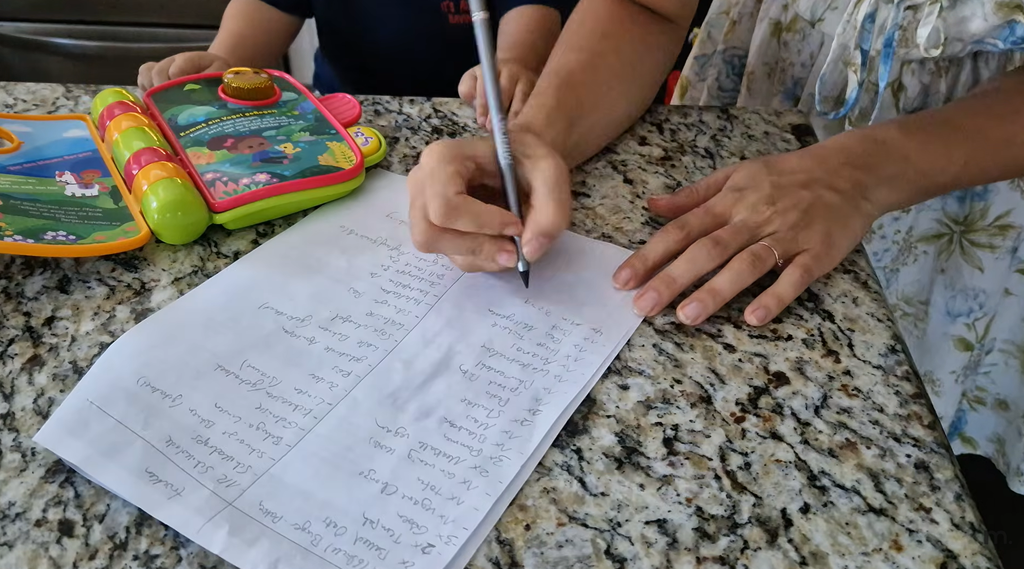
Every Sunday, we sit down and look at the week ahead.
We ask practical questions:
- Which days will everyone be home?
- Which days will only three people need a meal?
- Are we going out to eat at any point?
- Which evenings are busy?
- How many lunches do we need?
- Are there days when we need a quick freezer meal or leftovers?
For example, we might know that only three people will be home on Monday. Or we might have plans to go out with friends on Friday. That immediately tells us how many dinners we actually need to prepare.
From there, we create a rough outline.
We usually try to include:
- At least one meal using a “use me first” item.
- Two or three new recipes we have not tried before.
- A few reliable family favorites.
- Meals that fit the actual schedule for that week.
The point is not to make food boring. We still want meals to be enjoyable. We still want some variety. We still want to try new recipes.
But before we buy more food, we want to make sure the food we already own has a place in the plan.
The “Unwanted Item” Meal
One specific meal-planning habit has been especially useful for us: Every week, we plan at least one meal around an unwanted, forgotten, or difficult-to-use item.
For example, we had pasta made from edamame beans sitting on our shelf. Nobody in our family really liked it, but it was there. We also had half a jar of sunflower seed butter that had been purchased on sale and then sat in the cabinet because no one knew what to do with it.
These are exactly the kinds of things that end up living in a pantry for years if you do not intentionally use them.
So we move them into the “use me first” zone. Then, when meal-planning time comes around, we look for ideas.
Maybe that edamame pasta works better in a pasta bake with a flavorful sauce. Maybe sunflower seed butter can be used in cookies, energy bites, a savory sauce, or a smoothie. Maybe an ingredient that seemed unappealing on its own becomes useful when it is part of another recipe.
Sometimes the result is great. Sometimes we learn that we simply do not like a particular product and should not buy it again.
Both outcomes are valuable.
The goal is not to force yourself to eat food you hate forever. The goal is to learn from what is already in your kitchen instead of repeatedly buying things that do not fit your real life.
A Realistic Weekly Grocery Routine
If you are wondering how all five rules work together in normal family life, here is the basic rhythm that works for us.
At the beginning of the week, we look through the kitchen.
We check the “use me first” zone. We notice what is running low in our pantry zones. We review our fridge, freezer, and current leftovers. If we are using the pantry tracker, we update it.
Then we look at the schedule for the week.
We decide which meals need to happen on which days. We plan one meal around food that needs to be used, include a few favorites, and choose a couple of new recipes if we want to keep things interesting.
Before going to the store, we take photos of the pantry, fridge, freezer, and spices. If there is something we are unsure about, we can check the photos while shopping.
At the store, we buy what is actually needed—not what feels familiar, not what looks tempting in the moment, and not what we might already have three of at home.
When we return home, we put newer food behind older food. We place anything that needs attention in the “use me first” zone. We store food in the zones where we will use it most often.
Then, throughout the week, dinner starts with one question:
“What is in the use me first basket?”
This routine is not perfect. There are still busy weeks. There are still times when food gets wasted. There are still moments when someone buys something we already have.
But the difference is that the system makes those mistakes less frequent.
It helps us catch them before they become expensive habits.
How This Supports Frugal Living
Frugal living is often misunderstood.
Some people imagine it means never going out to eat, never buying anything enjoyable, constantly tracking every cent, or feeling guilty whenever you spend money.
That is not how I see it.
For our family, frugal living means being intentional. It means spending money on the things that truly matter to us and reducing waste in the areas that do not add real value to our lives.
Buying food that we throw away does not improve our quality of life. Buying four duplicates of something we already own does not make us happier. Feeling overwhelmed in a cluttered pantry does not make family meals easier.
The five kitchen rules help us spend less because they remove unnecessary spending—not because they force us into deprivation.
They also make daily life feel simpler.
Instead of standing in front of an overstuffed pantry wondering what to cook, we can see what is available. Instead of buying groceries based on memory, we can check our photos or tracker. Instead of constantly running out of one thing and overbuying another, we keep a more balanced amount of food in the house.
This is a form of simple living that has practical financial benefits.
How This Fits a Homesteading Lifestyle
Even if you are not living on a full homestead, these systems work beautifully with a homesteading mindset.
Homesteading is often about making more use of what you have. It can include gardening, preserving food, cooking from scratch, raising animals, reducing waste, building practical household skills, and becoming more intentional about consumption.
A well-organized pantry supports all of that.
If you grow vegetables, a “use me first” zone can help you prioritize fresh harvests before they spoil. If you preserve food, rotating jars and keeping older items in front helps make sure your efforts do not go to waste. If you buy bulk staples, the one-backup rule can prevent bulk buying from turning into forgotten clutter.
Pantry zones can also help if you have a lot of homemade ingredients. You might create a preserving zone for canned goods, a baking zone for home-milled flour and baking staples, a breakfast zone for homemade granola and oats, or a cooking zone for dried beans, broth, sauces, and spices.
The goal is the same whether your food comes from a grocery store, a garden, a farmers market, or your own pantry shelves: Use it well.
Food is a resource. Time is a resource. Money is a resource. A practical kitchen system protects all three.
How Grocery Savings Support Financial Freedom
Financial freedom is not only built through big financial decisions.
Of course, investing, increasing your income, paying off debt, building a business, and managing housing costs are important. But daily spending habits matter too—especially when they repeat every week.
Groceries are a recurring expense. Unlike a one-time purchase, they come back again and again. Even a small improvement in your grocery spending can create a meaningful annual difference.
For us, lowering our grocery bill from around $1,000 to around $600 per month created a potential savings of about $400 per month.
That money could become:
- Emergency savings.
- Debt repayment.
- Retirement contributions.
- Investments.
- A home improvement fund.
- Family travel.
- A car repair fund.
- Extra margin in a tight month.
- A buffer that makes life feel less stressful.
The point is not that every family should spend exactly $600 per month. Grocery prices, family size, dietary needs, location, culture, and lifestyle are all different.
The point is to find the waste in your own household.
Maybe your savings will be $50 per month. Maybe it will be $200. Maybe your biggest win will not be a lower grocery bill at all, but less food thrown away and fewer stressful last-minute store trips.
Every improvement creates more flexibility.
And flexibility is one of the most valuable forms of financial freedom.
Common Mistakes to Avoid
As helpful as these systems are, there are a few mistakes that can make them harder to maintain.
The first mistake is trying to create the perfect pantry overnight.
You do not need matching containers, beautiful labels, or an expensive organization makeover. Start with one basket for the “use me first” zone. Rearrange one shelf. Take a photo before your next grocery trip.
Simple systems are more likely to last.
The second mistake is treating the one-backup rule as a strict rule for every possible item.
There may be exceptions. If you live far from a grocery store, have dietary restrictions, buy in bulk because it genuinely saves money, or keep emergency supplies, you may need more than one backup of certain staples.
The principle is not “never stock up.” The principle is “do not buy blindly.”
The third mistake is making meal planning too complicated.
You do not need to plan twenty different recipes. You do not need to prepare restaurant-quality meals every night. A short list of realistic meals is much more helpful than a detailed plan you will abandon by Tuesday.
The fourth mistake is ignoring foods you do not like.
You can try to use unwanted items creatively, but if your family truly dislikes something, let that be useful information. Do not keep buying it because it was healthy, trendy, or on sale. Saving money also means not repeating purchases that do not work for your household.
The fifth mistake is expecting zero food waste immediately.
Some waste will happen. Life gets busy. Plans change. Children refuse meals they loved last week. Produce spoils faster than expected. The goal is not perfection. The goal is to improve your awareness and reduce waste over time.
A Simple 7-Day Challenge
If you want to try these ideas without overwhelming yourself, start with one small challenge this week.
On day one, create a “use me first” basket in your fridge.
On day two, check your pantry and identify duplicate items. Commit to buying no more than one backup for your most common products.
On day three, choose one area of your pantry and organize it by use instead of by food category. Start with breakfast or snacks because those are often easy zones to create.
On day four, take photos of your pantry, fridge, freezer, and spices before grocery shopping.
On day five, write down one ingredient that often gets wasted in your home.
On day six, look for one recipe that uses an item from your “use me first” zone.
On day seven, make a loose meal plan for the next week that includes one leftover, one pantry item, one family favorite, and one new recipe.
That is enough to get started.
You do not need to change your whole kitchen at once. One visible improvement can create momentum for the next one.
Final Thoughts
These five rules made a big difference for our family.
The “use me first” rule makes sure we know what needs to be eaten first. The one-backup rule stops too much food from entering the house. Organizing by zones instead of categories helps us function better in our own kitchen. The 30-second inventory method and pantry tracker show us what we have and help us spot patterns. Flexible meal planning makes sure the food we buy is actually used before it goes bad.
We now shop with much more intention. We waste almost nothing compared to before. And our kitchen feels so much less stressful—especially when we are trying to feed a family of four.
You do not need a perfect pantry, a complicated budget, or an extreme lifestyle to save money on groceries. You need a few simple systems that help you see, use, and enjoy the food you already have.
That is one of the most practical ways to build a more minimal, frugal, and financially free life—one grocery trip at a time.