People often assume that Germans must spend half their lives cleaning.
There is this image of the perfectly ordered German household: shoes lined up by the door, counters completely clear, laundry folded before it has had time to become emotionally attached to the chair in the bedroom. And yes, I have to admit that a good 90 percent of this is very much my personality. Our house is clean and organized most of the time, even though my husband and I both work full-time and we have two small children.
But here is what I do not do: I do not clean all day, I do not have a strict cleaning schedule, and I definitely do not reserve every Thursday afternoon for dusting baseboards.
Honestly, who dusts their baseboards every week? Or even every month?
There are things in life that deserve our time, and there are things that can wait until they actually need attention. I want a home that feels calm, pleasant, and welcoming, but I do not want to spend my weekends maintaining the illusion that nobody has ever lived in it.
Most weeks, we probably spend three to four hours total on cleaning and tidying. That includes a family, everyday messes, work, school, laundry, cooking, toys, shoes, jackets, dishes, and all the tiny objects that somehow reproduce on kitchen counters overnight.
The reason this works is not because we have an extraordinary amount of discipline or because I secretly enjoy cleaning toilets. It works because we follow a few simple principles that reduce the amount of cleaning we need in the first place.
For us, a clean home is not created by cleaning everything meticulously. It is created by knowing what matters, knowing where things belong, and knowing what can wait.
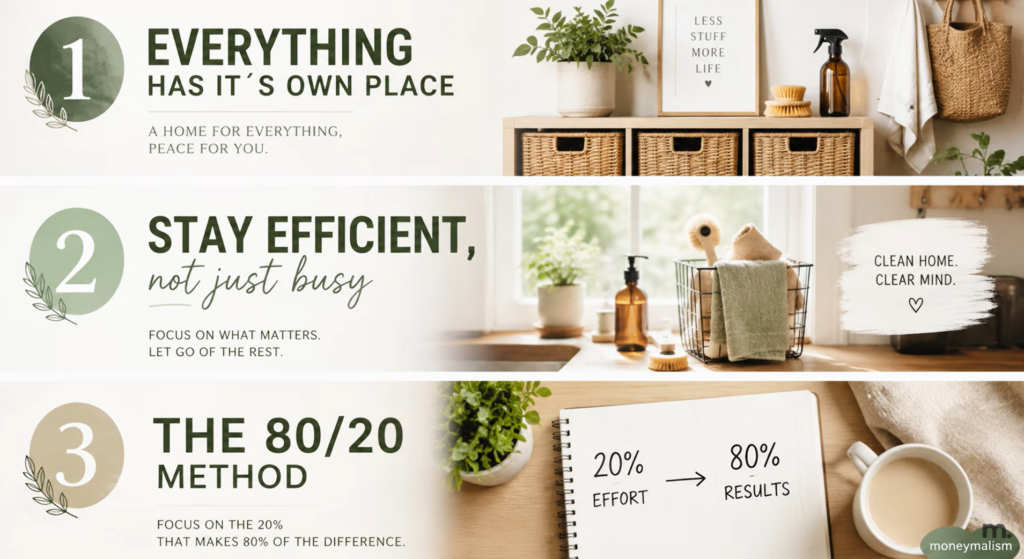
These are the three principles that make the biggest difference in our home:
- Everything has a place.
- Clean what actually needs cleaning.
- Focus on the small number of tasks that make the biggest visible difference.
None of this is revolutionary. But it is the kind of boring, practical system that quietly makes life easier over time.
1. Everything Has a Place
This is probably the most German part of our system.
In many German families, everything has a very specific place. Not just a vague area somewhere in the house. Not “the kitchen” or “the hallway.” A real place.
The keys have their place. The shoes have their place. The jackets have their place. The nail clippers have their place. The tape has its place. The scissors have their place, although somehow they still disappear every single time you need them.
And if you put something somewhere else, someone will notice almost immediately.
Growing up, this could be slightly annoying. You would put something down for two seconds, your mother would walk into the room, see it sitting there, and say something along the lines of: “Put that back where it belongs.”
At the time, I did not find this particularly charming.
As an adult, however, I understand why it works so well.
When every item has a home, tidying up becomes much less complicated. You do not have to stand in the middle of your house holding an object and wondering where it should go. You do not create a temporary pile on the dining table because you are not sure what to do with it. You do not place your jacket on the chair “just for a second,” only to discover two weeks later that the chair has become a full-scale storage facility.
I think almost every home has one of these chairs.
The chair starts out innocent. A sweater lands on it. Then a bag. Then a pair of jeans that are not quite clean but not quite dirty. Then a jacket. Then, somehow, a charger, a book, three receipts, and possibly a single sock. At that point, the chair is no longer furniture. It is a lifestyle.
The reason clutter builds up is often not laziness. It is indecision.
When we do not know where something belongs, we postpone the decision. We put it down somewhere visible, tell ourselves that we will deal with it later, and then later becomes tomorrow, next weekend, or eventually a mysterious future version of ourselves who is apparently much more organized than we are.
That future person never arrives.
So in our home, I try to make the decision once. Every item gets a designated place, preferably somewhere that makes sense for how we actually live.
Shoes belong near the entryway. Cleaning products belong close to the places where they are used. Kids’ art supplies should not live in the farthest cabinet in the house if the children use them every afternoon. Frequently used kitchen tools should be easy to reach, while the waffle iron you use twice a year does not need prime countertop real estate.
The goal is not to create a house that looks like a showroom. The goal is to make it easy to put things away.
And that is an important difference.
A home organization system only works if it works on an ordinary Tuesday evening when everyone is tired, someone is asking for a snack, the dishwasher needs to be unloaded, and there is probably a small child looking for something that was definitely in their room five minutes ago.
If the system is too complicated, nobody will use it.
The one-movement rule
One small habit that helps enormously is what I call the one-movement rule.
If I am already holding something, I try not to put it down in the wrong place first.
The cup goes directly into the dishwasher instead of stopping on the kitchen counter for a little break. The jacket goes directly onto its hook instead of onto the chair. Dirty laundry goes into the hamper, not onto the bed, the floor, or the edge of the bathtub.
This may sound almost too simple to matter, but it is one of those habits that prevents clutter before it begins.
The problem with “I’ll just put it here for a second” is that seconds tend to become days. Especially in a busy family home, every small temporary decision becomes another thing to deal with later.
When you put something away immediately, you only have to touch it once.
When you put it down somewhere random, you have created a future task for yourself: you will have to see it again, notice that it does not belong there, pick it up again, remember where it belongs, and put it away later.
That is at least two movements. Usually more.
The one-movement rule is not about perfection. Sometimes you will absolutely put a sweater on a chair. I do too. But when you can make putting something away the automatic first step rather than the eventual second step, the house stays calmer without requiring a major daily reset.
And of course, owning less helps.
The fewer things you own, the fewer things need a home, need to be cleaned, need to be stored, need to be moved, and need to be mentally managed. Minimalism, at least for me, is not about owning as little as possible. It is about owning what genuinely adds value to your life and letting go of the things that only create work.
2. Clean What Is Dirty, Not What the Calendar Demands
I used to try cleaning schedules.
You know the kind: Monday is laundry day, Tuesday is bathroom day, Wednesday is dusting day, Thursday is vacuuming day, Friday is deep-clean-the-kitchen day, and by Saturday you are too tired to enjoy the weekend because apparently your home has become your second employer.
For some people, a detailed cleaning schedule is genuinely helpful. If it gives you structure, reduces decision fatigue, and makes your life easier, there is nothing wrong with using one.
For me, though, rigid schedules created more pressure than peace.
I would look at a task written on the calendar and feel like I had failed if I did not do it, even when the room was perfectly fine. I would clean a guest bathroom that nobody had used in weeks simply because the schedule said it was bathroom day. I would feel behind on chores that did not actually need to be done.
Eventually, I realized that I did not need another list of demands in my life.
I needed a more efficient way of noticing what actually required my attention.
So now I clean when something is dirty.
That is it.
If the kitchen floor needs to be vacuumed because everyone has been walking in and out, the kids have dropped crumbs, and the dog has brought half the garden inside, then I vacuum it. If the guest bathroom has barely been touched all month, I leave it alone until it actually needs cleaning.
This does not mean letting everything become disgusting and dealing with it only once the situation is beyond saving. It simply means paying attention to your actual home rather than cleaning according to an imaginary standard.
Some things need frequent cleaning because they are used frequently. Others do not.
The kitchen sink may need attention every day. The family bathroom may need attention twice a week. The windowsill in the guest room may not need anything for months. There is no prize for polishing a surface that is already clean.
Stop cleaning the whole house at once
One of the biggest changes I made was giving up the idea that cleaning has to be a large, exhausting event.
We used to have Saturday morning cleaning sessions, and I honestly hated them. The entire house would feel like one giant unfinished project. There was always more to do, more to notice, more to feel guilty about, and suddenly half the weekend had disappeared into vacuum cleaner noises and resentment.
Now I prefer quick room resets.
I choose one room, set a timer for 10 or 15 minutes, and focus only on making that one space feel better. Not perfect. Better.
The difference is surprisingly powerful.
When you spend 10 focused minutes in one room, you can often create a visible result: the floor is clear, the surfaces are reset, the cushions are back on the couch, the toys are put away, and the room looks calm again. That small success gives your brain the feeling of progress, which makes it easier to continue another day.
By contrast, doing one minute of random cleaning in every room often feels like you have been busy without actually changing anything. You walk around the house, move things from one place to another, get distracted, start three tasks, finish none of them, and somehow the house can look worse than before.
To avoid that, I usually start on one side of the room and work my way across.
For me, it is left to right.
It sounds almost ridiculous, but it prevents the feeling of being overwhelmed. Instead of seeing an entire messy room, I see one small section at a time. I clear it, move on, and slowly create order without constantly jumping around.
You can go clockwise, start at the door, work from top to bottom, or choose any system that feels natural to you. The point is not the direction. The point is to stop making hundreds of tiny decisions.
Pick a starting point. Keep moving. Finish the room.
3. Use the 80/20 Rule for Cleaning
The third principle is the one that saves the most time: focus on the 20 percent of tasks that create 80 percent of the visible result.
Not every cleaning task has the same impact.
Cleaning the coffee machine every week may be nice, but it probably will not make your house feel dramatically calmer. Scrubbing a shower tile with a toothbrush may be satisfying if that is your thing, but on a stressful day it is probably not the task that will make the biggest difference to how your home looks and feels.
The goal is not to have a perfect room.
The goal is to create momentum, reduce visual clutter, and make the house feel peaceful enough that you can actually enjoy being in it.
For me, there are a few high-impact tasks that make almost any room look better very quickly.
Clear the floor first
Floors make a bigger visual difference than most people realize.
When a room has toys, shoes, bags, laundry, random cables, paper, and forgotten water bottles spread across the floor, it feels messy even if everything else is technically clean.
So I usually start there.
Anything that does not belong on the floor gets picked up and put back in its assigned place. If everything has a home, this step becomes much faster. You are not creating new piles; you are simply returning things to where they already belong.
A clear floor creates immediate calm, especially in the entryway, living room, bedroom, and kitchen.
Reset the main surfaces
After the floor, I look at the surfaces that catch your eye first.
The kitchen counter. The dining table. The coffee table. The bathroom vanity. The dresser in the bedroom.
A clear countertop makes an entire room feel cleaner, even if you have not deep-cleaned every drawer or polished every cabinet handle. Visual clutter has an enormous effect on how stressful a space feels, and removing it often creates a bigger change than any expensive organization product ever could.
This is why I am careful about what lives permanently on our counters.
The more things are allowed to stay out, the more visual noise the room has. A few useful and beautiful items are fine. But when every surface becomes a storage zone, the house starts to feel busy even when it is technically tidy.
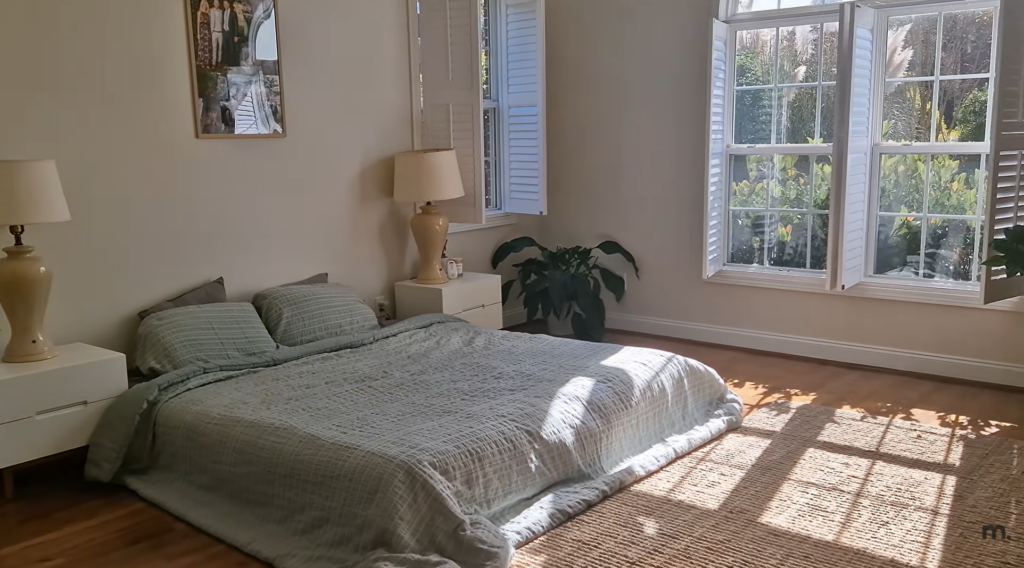
Make the bed
Making the bed is one of the smallest tasks with one of the biggest returns.
It takes very little time, but it changes the whole feeling of the bedroom. Even if the room is not perfect, a made bed creates one large, calm surface. It makes the space feel more intentional and less chaotic.
And psychologically, it often creates momentum.
You make the bed, the room looks better, you notice the clothes on the floor, you put those away, then you open the curtains, and suddenly the room feels like somewhere you actually want to be.
You do not need a hotel-perfect bed with eighteen decorative pillows. You just need to pull up the blanket and give yourself one peaceful surface to look at.
Clean the traffic routes
On busy days, I focus on the areas we actually use most.
The entryway. The kitchen. The living room. The hallway. The main walkways through the house.
I do not need to vacuum every corner every time. Deep cleaning has its place, of course, but daily life is not a deep-cleaning competition. If the rooms people see and use most often are reasonably clean, the whole house feels more manageable.
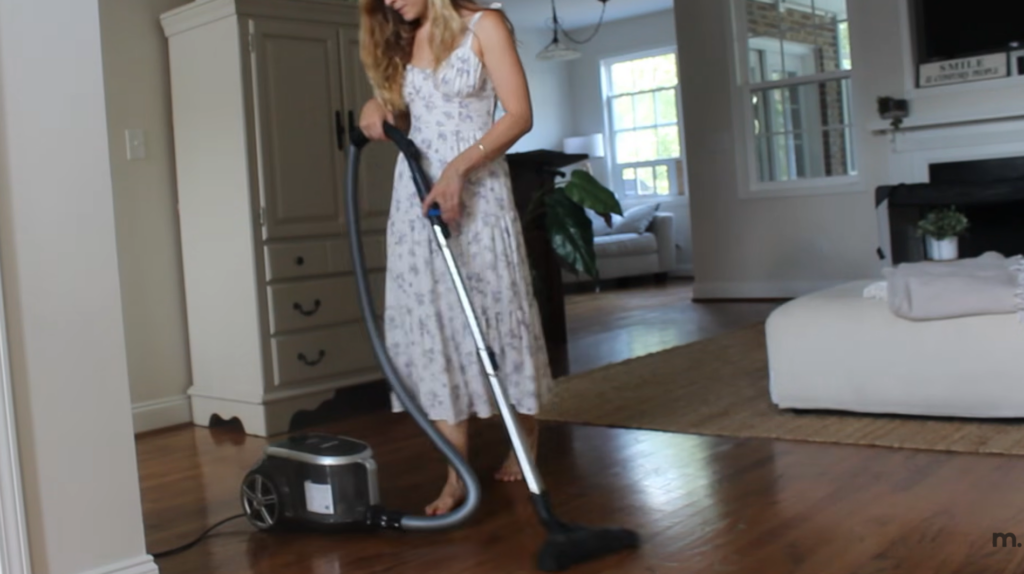
We also have a robotic vacuum cleaner, and I try to run it once a day. It is not a magic solution, and it certainly does not replace all cleaning, but it removes a surprising amount of everyday dust, crumbs, pet hair, and dirt before it has the chance to collect in corners.
Small systems like that are worth considering because they reduce the amount of work you have to do manually later.
Reset the kitchen every evening
If I had to choose one cleaning habit that creates the biggest sense of calm in a home, it would be resetting the kitchen before bed.
A clean sink and clear kitchen counters can make the entire house feel clean, even when the rest of the house absolutely is not.
There is something deeply unpleasant about waking up to yesterday’s dishes, crumbs on the counter, clutter around the sink, and the feeling that you are already behind before the day has even started. I do not need the kitchen to be perfect every night, but I like it to be reset enough that morning feels like a fresh start.
This is especially helpful in a family home, because the kitchen tends to become the center of everything: meals, snacks, school papers, water bottles, shopping bags, lunchboxes, toys, and random things that somehow end up there.
When the kitchen is reset, the whole home feels more under control.
Our Five-Minute Family Reset
One habit has made more difference than almost anything else: our five-minute family reset before bedtime.
Before the kids get their bedtime story, all four of us take five minutes and put things back where they belong.
Usually, everyone takes one area. I often reset the living room and bring dinner-related items toward the kitchen. My husband takes care of the kitchen. The children clean up their rooms or gather the things they have brought into the shared spaces during the day.
It is not a long cleaning session. It is not meant to be.
Five minutes is short enough that nobody feels overwhelmed, but when four people contribute, it adds up to 20 minutes of combined effort every evening. More importantly, it stops clutter from becoming a giant weekend problem.
The children also learn that tidying up is not something one exhausted person does alone after everyone else has gone to bed. It is simply part of closing the day together.
That matters.
Because there is nothing particularly peaceful about one person silently spending an hour every evening cleaning up after the rest of the family, becoming increasingly annoyed, and then trying to pretend everything is fine. A home is shared, which means maintaining it should be shared too, in an age-appropriate and realistic way.
The five-minute reset is not about raising children who are terrified of leaving a toy on the floor. It is about teaching them that the things we use deserve to be cared for, and that everyone in the family helps create the kind of home they want to live in.
A Clean Home Does Not Need to Be Perfect
The older I get, the less interested I am in having a house that looks permanently untouched.
A home should look lived in. Children should be allowed to play. People should be able to cook, relax, build things, make art, invite friends over, wear their favorite sweater twice, and occasionally leave a cup on the counter without turning the entire household into a crisis.
But there is a difference between a lived-in home and a home that constantly drains your energy.
For me, the goal is not perfection. It is ease.
I want to walk into our home and feel like I can breathe. I want to know where things are. I want to avoid spending Saturday morning cleaning rooms that were already clean while the people I love are waiting to do something more meaningful.
A calm home is not created through endless cleaning. It is created through a few practical decisions that make cleaning less necessary:
- Give the things you keep a real place to live.
- Put items away the first time you touch them.
- Clean what is actually dirty instead of obeying an exhausting schedule.
- Work room by room rather than trying to rescue the entire house at once.
- Focus first on clear floors, clear surfaces, a made bed, clean traffic areas, and a reset kitchen.
- Let everyone in the household contribute, even if it is only for five minutes.
That is the German-efficient way I try to keep our home clean and organized most of the time: not perfect, not meticulous, not magazine-ready, but calm, functional, and easy enough to maintain in a real life with work, children, dishes, deadlines, and plenty of better things to do.
Because a clean home should support your life.
It should not become your life.