I think most decluttering methods fail for one simple reason: they’re exhausting. You’re supposed to pull every single item out of your closet, make hundreds of tiny decisions, ask yourself if something sparks joy, and four hours later you’re sitting in a pile of clothes wondering why you even started. I don’t know about you, but as a full-time mom of two, I simply don’t have the time or the energy to declutter for hours on end and lose an entire weekend to my closet.
And since I’m northern German, I like things simple, fast, rational, and efficient.
When I first moved to South Carolina, I ended up with two completely different closets. One suited for northern German weather — lots of sweaters, lots of pants. And here in South Carolina, none of that really worked for the climate, so I had to buy a ton of summer dresses, linen pants, and the like. I ended up with way too many clothes. I was overwhelmed and annoyed by all the choices I had to make every single morning, and nothing really matched anymore.
So this combination of too many clothes and not enough time is what pushed me to come up with a rational, effective method that pleases my German brain. This method helps you identify the clothes you actually wear and makes it surprisingly easy to let go of the rest — without a ton of effort, work, or time. And most importantly, it helps you avoid the cycle of decluttering to make space, buying even more stuff, cluttering again, and wanting to declutter again. That’s not minimalism — that’s just reorganizing your shopping habits, aka playing closet Tetris.
If you’re new here: I’m Uta, a German living in South Carolina, and on this blog we talk a lot about escaping consumer culture through intentional money and consumption choices. Unlike a lot of minimalism content out there, the goal isn’t to own as few things as humanly possible — it’s to save money and need less, so you can fund the life you actually want.
Okay, enough about me. Let’s dive into the closet declutter.
The Real Cost of a Cluttered Closet
The average American spends around $850 a year on clothing and footwear, even though they regularly wear only about 10% of their wardrobe. Now imagine cutting that down to just $200 a year, by only buying what you truly need and getting most of it secondhand. That’s $650 a year that could go toward your actual goals instead.
And sure, saving $650 a year doesn’t sound thrilling on its own. But make it a habit, and over 10 years that’s $6,500. That could be a used tractor for your homestead dream, part of a down payment, or several months of living expenses. That’s basically the freedom you traded away for clothes you barely wear.
If you currently wear only 10% of your closet, and after this method you’re regularly wearing 85%, that’s a massive win. You probably have your favorite shirts, your favorite jeans, your favorite sweaters — and then there’s everything else, kept around because “I might wear this someday,” “this was so expensive,” “I used to love this,” “maybe I’ll wear it again if I lose weight,” or “I genuinely have no idea what to pair this with.”
My goal here isn’t to get you down to owning as few items as possible. It’s to increase the number of clothes you actually want to wear, until you reach a point where you don’t feel the urge to buy more — because you’re satisfied with what you already have. From there, you’ll probably stop buying new clothes altogether and have more money to put toward your dream life.
Here’s What We’re Going to Do
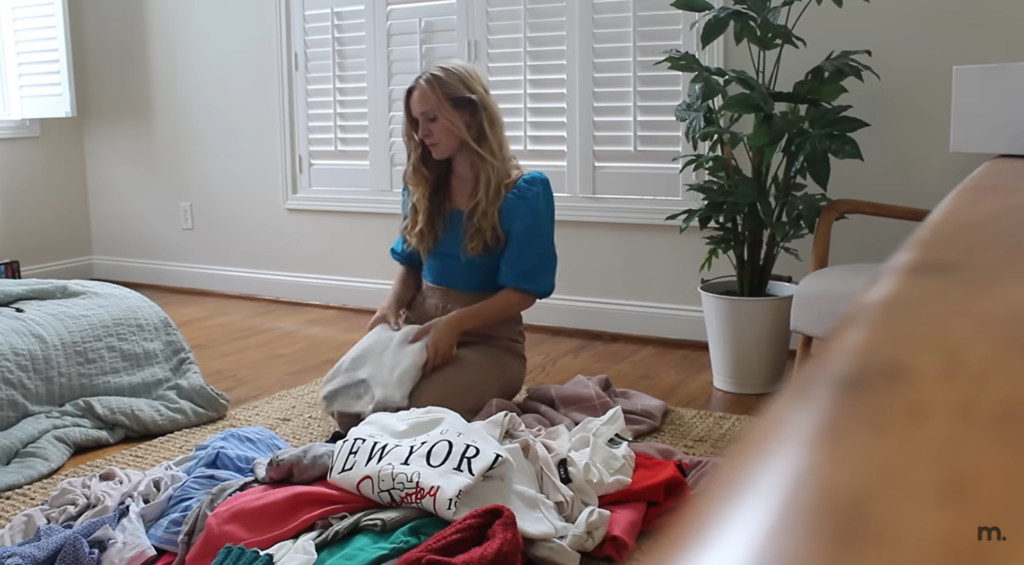
Step 1: Split your wardrobe into two seasons. Classic approach — spring/summer and fall/winter. Depending on what season you’re in, keep only those clothes accessible, and move the off-season stuff under the bed, onto a shelf, into storage, wherever.
Step 2: Separate hanging from folded. Push all your hanging clothes to one side of the closet, and take all your folded clothes and put them on the floor, under a shelf, or wherever there’s room. Bonus points if you pick a spot that feels a little inconvenient — that discomfort is exactly what nudges you to actually work through it instead of letting it sit for months.
Think of this as a modified version of the reverse hanger method. Every time you wear something and it ends up in the laundry, you wash it and hang it back on the left side of the closet (or back on the shelf). You’re essentially collecting evidence. And because you’re working left to right, your brain registers it as real progress — not just some random hanger shuffle.
After a few weeks, you’ll clearly see: these are the clothes I actually live in, and everything else is just taking up space.
The 60-Day Rule (and the Discipline Part)
I recommend doing this for around 60 days, then checking what’s left untouched on the other side. But before you declutter anything, there’s one rule that makes this whole process actually work: you’re not allowed to buy anything new until you’ve worn everything you already own at least once.
Yes, that takes discipline. And we Germans are famously fond of discipline, so honestly? I love this part.
One thing I noticed growing up in Germany is a more practical relationship with clothes and belongings in general. Not everyone, obviously, but there’s often less emphasis on constantly upgrading or always having the best of the best — and more emphasis on what actually works for your life. So when I declutter, the goal was never a “perfect,” Pinterest-worthy capsule wardrobe. It’s a wardrobe that’s perfect for me and my actual lifestyle, getting maximum value out of what I already own.
So before you get rid of a single thing, get creative and squeeze more use out of what’s already yours.
The Pieces You’ve Been Avoiding
After a couple of weeks, you’ll notice which pieces you keep avoiding. Pick one every morning and ask yourself: do I genuinely dislike this, or do I just not know how to style it? If it’s the latter, hop on Pinterest, search for outfit ideas, and try combinations you normally wouldn’t. Sometimes a forgotten shirt becomes a new favorite. Sometimes you realize you never actually liked it. Both are useful discoveries — and somewhere in this process, you might start to feel a genuine sense of abundance: “Wow, I actually own a lot of great clothes already.” You’ll start appreciating combinations you can already pull off, and how many days you can go without repeating an outfit, simply because you have so much more to choose from than you thought.
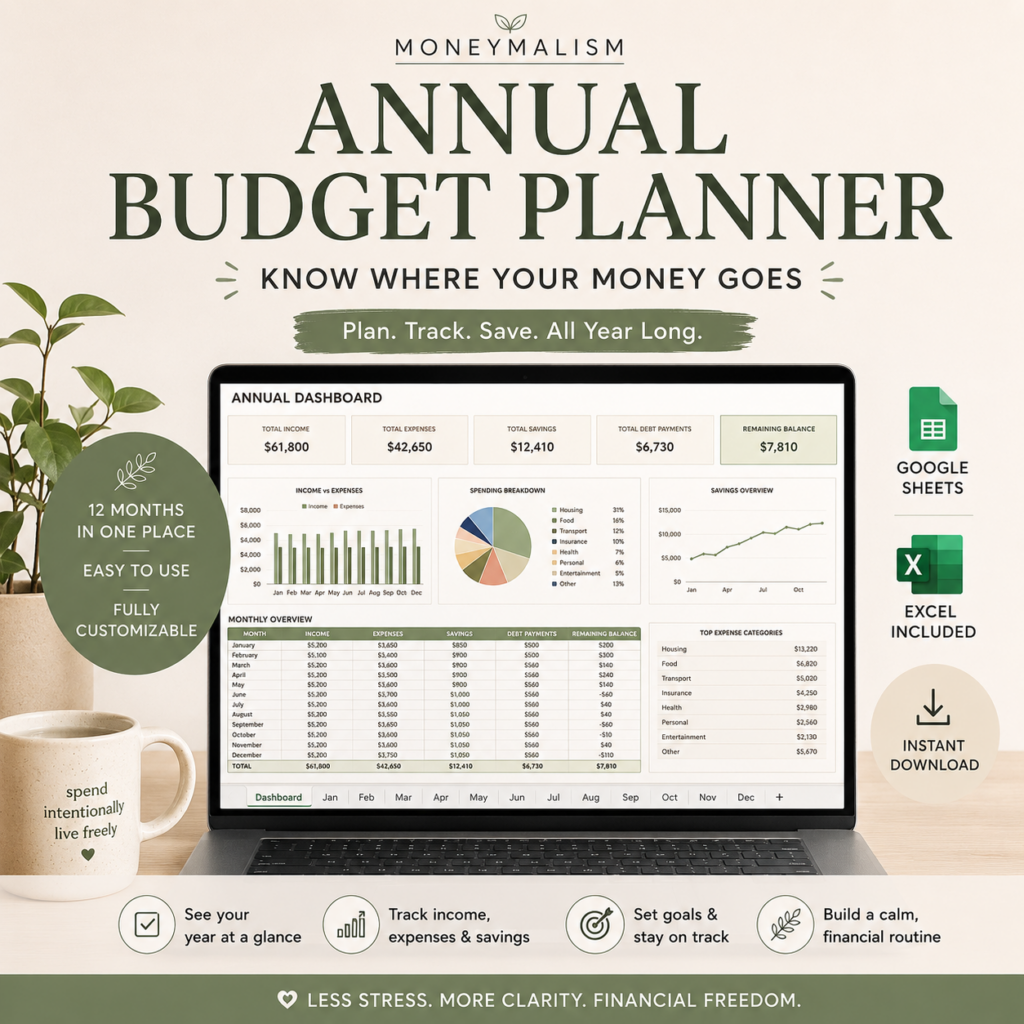
(By the way — if you want to get your closet and your finances on track at the same time, I’ve got a free minimalism planner bundle and a budget planner on my website. Worth a look if either one needs a little rearranging.)
Wanna get your own budget under control? Then check out my Annual / Monthly Budget Planner Spreadsheet!
The “Twice Uncomfortable” Rule
Now that you’re wearing more of your closet and getting creative with the leftovers, you’ll start to feel pretty quickly which pieces still fit your life — and which ones just don’t. For anything you’re still unsure about, here’s another rule I use: if I wear something and feel uncomfortable in it twice — too tight, not my style, too short, whatever — it’s gone. Doesn’t matter if it was expensive. Doesn’t matter if it’s trendy. If the fit is wrong, the fabric’s itchy, or I’m constantly adjusting it, I let it go. Life is too short to wear clothes that make you feel uncomfortable.
Try to be rational about your clothes instead of emotional. If you’re a mom living in the rural countryside, you’re probably not going to wear all your heels and nice dresses in the next three years — those are just taking up mental and physical space. But if you’re a lawyer in New York City, your needs look completely different. Let go of the fantasy version of yourself — the one you had in mind when you bought that piece, or the one you’re still picturing if you lose weight someday. Be realistic about who you are and what your actual daily life requires, even if you don’t love the answer at first.
After 60 (or 90) Days
At the end of two or three months, you’ll be able to draw a clear conclusion: there are things you haven’t touched the entire time, that you’ve clearly been avoiding, and that not even Pinterest could save. That’s your answer. From there, it can either go, or it can be repurposed — given to friends, turned into a sleep shirt, a cleaning rag, or just properly retired.
Personally, I like repurposing old shirts as pajamas or garden shirts, and old pants for gardening. Which, actually — can I ask you something? Do people really buy pajamas? I don’t think I’ve ever bought a single pair in my life. I just wear old leggings — I’m still wearing my old pregnancy leggings to bed because they’re incredibly comfortable. Same story with gardening clothes. Do people actually buy clothes specifically for sleeping or gardening? Genuinely curious — let me know in the comments, and if you do, I’d love to know why. Most of us already own plenty of perfectly good clothes that just aren’t stylish anymore, or don’t fit quite right, but are still totally fine for a second purpose. I wear my old t-shirts until they get holes, and then I toss them.
The Point of All This
The best part about this method is that it doesn’t ask you to become a different person. You don’t need a capsule wardrobe. You definitely don’t need to spend an entire Saturday buried in piles of clothes. You just pay attention, and keep going. Little by little, you learn to appreciate what you have and get more out of what you already own. It’s simply a matter of consistency, discipline, and choosing rational over emotional when it comes to your clothes.
The goal was never to own as few clothes as possible. The goal is to need less going forward. And every time you need less, you get a little bit closer to freedom.
Stay strong, my dear money minimalist. Thank you for being here today. If you’re into content about minimalism, saving money, financial freedom, and living a slow, intentional life, I’d love for you to become a new follower on my YouTube Channel — and I’ll see you in the next post.