If you’ve clicked on this article, chances are high you own too much stuff — and you’re either not sure where to even start decluttering, or you’re just plain tired of the same recycled advice. The one-in-one-out rule. The packing party. Marie Kondo’s “does it spark joy?” question. The classic donate-keep-sell piles.
Maybe you’ve tried all of them. And yet, somehow, neither your piles of clutter nor your bank account have gotten significantly better.
Good news: that’s exactly the problem we’re going to tackle today.
If you’re new here, I’m Uta, and this blog — moneymalism — is all about minimalism, simplifying your life, and saving money so you can actually fund the life you want. All in a German, no-nonsense, efficient kind of way.
Why Most Decluttering Methods Don’t Actually Work
Here’s the uncomfortable truth: most decluttering methods only treat the symptoms. They don’t cure the cause.
We’ve been handed method after method — sorting piles, minimalist checklists, guilt-based questions about joy — but none of them actually address why we accumulate too much stuff in the first place. It’s a bit like taking painkillers for a problem that needs surgery. You feel better for a moment, the pile shrinks, and then a few months later you’re standing in the same spot, surrounded by new clutter, wondering what went wrong.
So today, I want to introduce a completely different approach. A way to declutter your home that doesn’t require you to burn an entire weekend, that is sustainable long-term, and that actually addresses the root cause of clutter: mindless buying.
Here’s the wild part — after 30 days (or longer, if you want to extend it), you won’t just notice that you’ve gotten rid of a lot of things. You’ll notice that your entire relationship with your belongings, and your consumption habits, has shifted.
What Minimalism Actually Means to Me
Before I get into the method, let me clarify something, because I think this is where a lot of people get stuck before they even begin.
To me, minimalism isn’t about counting every single item you own like it’s some kind of competitive sport. It’s not about deserving to be “a better person” because you own fewer things. That framing is exhausting and, frankly, a little judgmental.
Minimalism, to me, is about creating space for the things that genuinely matter to you.
In my own life, I ask every object to have a job. It either needs to make my life more efficient, more comfortable, or better in some tangible way. And if something is just sitting there draining my energy — visually, mentally, physically — it needs to go.
The Real Reason You’re Stuck (Hint: It’s Not About Losing Things)
Here’s what I think is really going on when people hesitate to start decluttering, or when they start and then quietly give up halfway through.
We think decluttering is fundamentally about losing things. About subtraction. About giving stuff away, throwing stuff out, having less.
But what if the first step in decluttering wasn’t about removing something at all? What if it was about reconnecting with everything you already own — and gaining something in the process? Not more possessions, but perceived value.
Try this small experiment: think about your home right now. If I handed you a blank piece of paper and asked you to write down every single item you own, how far would you get?
Go ahead — try it in the comments if you want. I promise it’s harder than it sounds. Do you know every kitchen gadget currently rotting in the back of your cabinet? Can you name every half-used bottle of shampoo lined up in your shower?
Here’s my theory: most of us don’t actually have a problem with owning too much. We have a problem with not seeing, not using, and not appreciating what we already have. And when we stop seeing and using what’s already ours, our brains naturally start scanning for something new. Which, in plain terms, means: we buy more.
So for the next 30 days, we’re going to flip the script. Instead of hunting for something new, we’re going to rediscover what we already own.
Where This Idea Came From: My Wardrobe Experiment
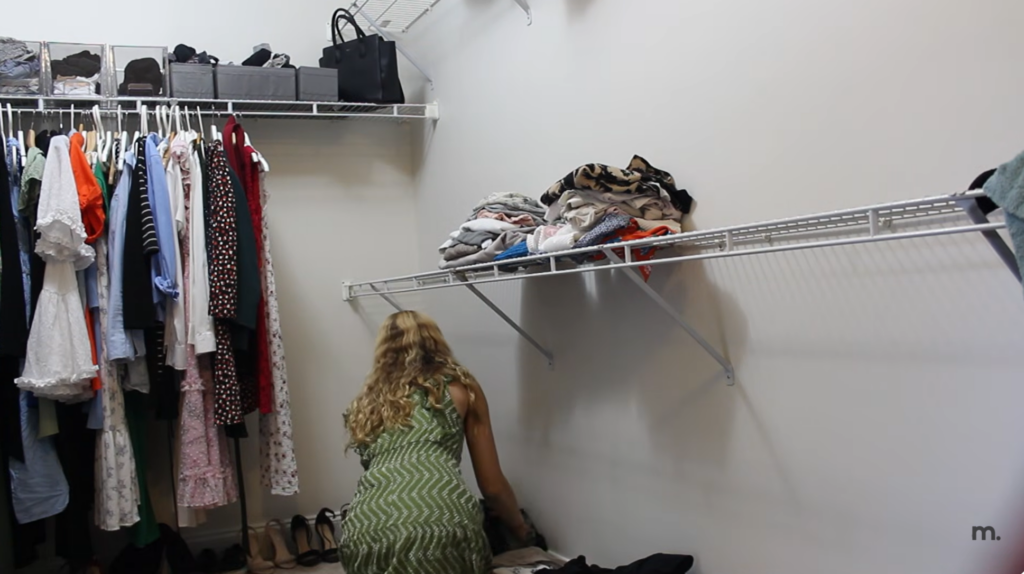
This whole concept actually started with my closet, not my entire home.
If you haven’t already, go check out my earlier video/post about what I call the “Java Method,” where I explain how I decluttered 70% of my wardrobe with just one hour of actual sorting work. The trick? I forced myself to wear every single item in my closet before I allowed myself to buy anything new.
And somewhere along the way, it hit me: why stop at clothes? Why not apply the exact same logic to my entire home? Use every single item before I’m allowed to buy something new — in any category.
Here’s the magic of it: when you start actually using what you already have, something shifts. You begin decluttering naturally, because you’re finally experiencing your belongings again, which means you can make a rational, informed decision about whether they still make sense for your life — instead of guessing based on vague memories or guilt.
Why This Method Works: It’s a Decluttering Process and a No-Buy Challenge in One
I genuinely love this method because it quietly combines a decluttering process with a no-buy challenge at the same time, without feeling like either one.
When your rule becomes “I have to use every single item in my home — or at least in one category — before I buy anything new,” something interesting happens psychologically: it unlocks a sense of creativity and abundance, rather than restriction.
Let me give you a few concrete examples of what this can look like in real life:
- The kitchen gadget graveyard. Maybe you open your kitchen cabinet and spot a juicer you bought two years ago, convinced it would transform your mornings. It didn’t. But instead of donating it out of guilt without ever using it, you commit to one week of homemade juice instead of your usual Starbucks order. Suddenly you’re saving money and finally finding out whether that juicer earns its cabinet space.
- The overlooked wardrobe. You open your closet and, instead of feeling overwhelmed, you think: “I actually have so many clothes — let me look up some outfit inspiration on Pinterest and work with what’s already here.” (Yes, I know — I’ve told myself a hundred times that Pinterest is basically clothes for the internet. I still can’t quit it. We all have our thing.)
- The half-used beauty drawer. You go through your bathroom cabinet and realize that face cream that never worked for your face might be perfect as a body lotion. Or that shampoo that never quite suited your hair could double as a shower gel.
That feeling — of using what you already own — is powerful precisely because it doesn’t feel like restriction. It feels like abundance. Not because you bought more, but because you’re finally appreciating what’s already yours.
How to Actually Structure the Challenge
Now, let’s be real: if you’re not already a fairly advanced minimalist, using every single item in your home within 30 days is simply not realistic. So here’s how I structure it instead.
I create categories, and I rotate through them across the year. Each day, I pick one category and use at least one item from it. Then, the following month, I repeat the process with a new category (or come back around to an old one).
I can already hear what you’re thinking: “But if I have 30 pieces of jewelry and I only use one per month, it’ll take me 13 months to get through my whole jewelry box!”
Fair point. But here’s what actually happens in practice: the moment you pick one item from your jewelry box and think, “this is the one I’m wearing today,” and you see the other 29 pieces sitting there next to it — it often kickstarts the decluttering process on its own. You’re already standing in front of the box anyway. A lot of the time, I ended up going through the entire collection, even though my plan was only to pick one piece. So those extra items get to leave right then and there, instead of waiting another six months for their turn.
Think of it as tricking your own brain into starting the decluttering process, one small nudge at a time.
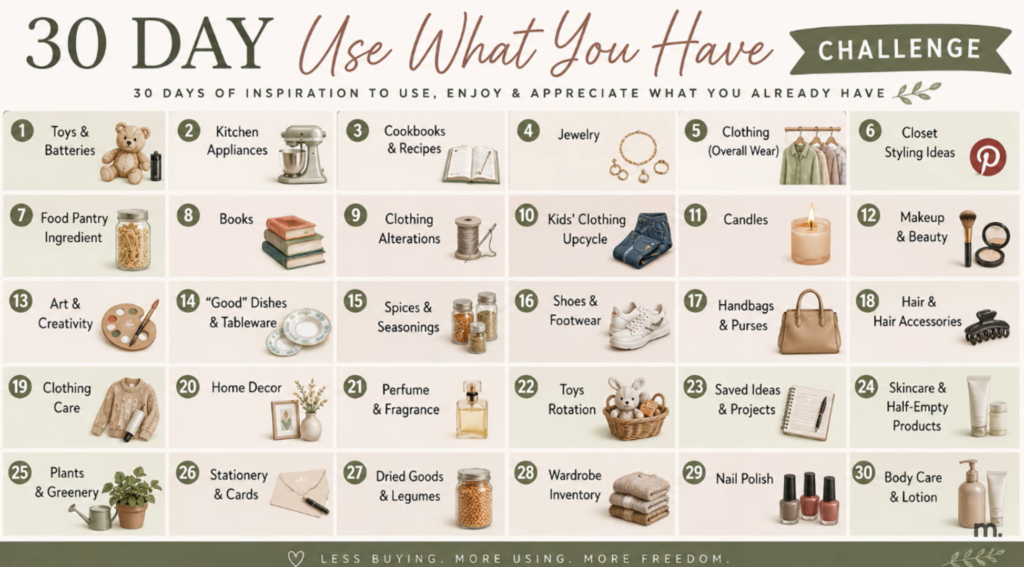
Real Categories, Real Examples
Here’s how I’ve actually applied this in my own home, category by category:
Kids’ toys. One of the simplest wins was something embarrassingly small: replacing dead batteries in a toy that had been sitting untouched in my kids’ room for months. Nobody had taken the two minutes required to fix it. Once it worked again, something that felt completely useless turned into an entire entertaining afternoon.
Kitchen tools. Many of us own kitchen gadgets purchased with the very best of intentions — a pasta machine, a bread maker, some specialty baking tool that seemed essential at the time. Instead of adding another appliance to the collection, try turning one of those forgotten tools into a date night at home. Get your partner involved, dust off the fancy gadget, and actually cook with it.
Cookbooks. We are constantly collecting inspiration, and then somehow still end up making the same five meals on repeat. One day, I simply pulled a cookbook off my shelf and cooked an actual recipe from it — no scrolling, no new cookbook purchase, just using what I already owned. Try the same thing yourself.
Jewelry. This category is such a good example because it’s something we tend to completely forget about. We wear the same few pieces on repeat simply because they’re easy to reach and sitting right there on the counter, while everything else gets forgotten in a drawer. Pull out a necklace you haven’t worn in months, or a pair of earrings buried in a drawer — it can completely change the feel of an outfit without spending a single euro or dollar on something new.
Crafting supplies. If you’re anything like me, you may have fallen victim to a hobby trend at some point. I’ll admit it: I bought a full set of watercolor supplies during the height of the watercolor hype on TikTok — before I deleted the app entirely. Instead of letting them collect dust, pull up a tutorial, gather some friends for a crafting afternoon, and actually put the supplies to use.
Beauty and bathroom products. Put your half-used products somewhere visible instead of hidden in the back of a cabinet — this applies especially to opened body lotions or bathroom items. Try repurposing a hand cream as a body lotion, or cut open an “empty” tube to use up the last bit of product hiding inside.
Everyday items you’re “saving.” Sometimes we skip the nice dishes for an ordinary weekday lunch, or we save the candles for some hypothetical special occasion that never quite arrives. Why do we always keep the good stuff reserved for “good occasions”? I genuinely don’t have a satisfying answer to that. The special occasion is that you’re here, and you’re alive. Start using the good things now.
What To Do With Items That Don’t Make the Cut
Here’s the natural next step: if, after actually using something, you realize it truly doesn’t fit your life anymore — it doesn’t match your lifestyle, it’s not enjoyable to use, it simply doesn’t belong — let it go the same day.
I keep a box for this purpose, usually just sitting in my laundry room. That’s it. You don’t need to block off a free Saturday. You don’t need to empty out your entire house in one exhausting session. You just need a few minutes each day to pick up one forgotten item and actually use it for its original purpose. Those tiny, unglamorous actions compound over time into a genuinely different home.
Why This Feels Uncomfortable (And Why That’s the Point)
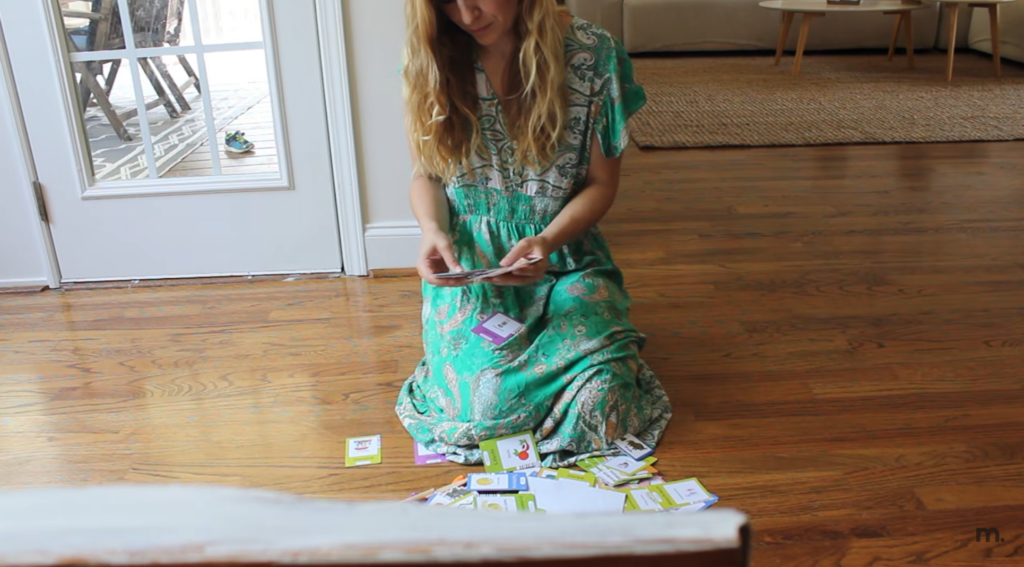
I want to be honest with you: this method can feel uncomfortable, especially at first.
You’ll come face to face with just how much stuff you own that you actually don’t want to use anymore. You might feel a little embarrassed at how much you bought, and how quickly your brain adjusted to having “new” things — only to stop noticing them within weeks.
Here’s the strange psychological trick at play: sometimes new things feel exciting simply because they’re new. But when you haven’t seen or touched an item in six months, it can genuinely feel new again — releasing that same little hit of dopamine you’d get from an actual purchase.
Once you fully understand how much you already own, and experience just how long it actually takes to go through every single item in your home — how much effort it takes to hold each thing, maintain it, decide what to do with it — buying something new starts to feel almost ridiculous.
This, I believe, is where the real cure for compulsive shopping habits begins to take hold. You start pausing before a purchase and asking yourself a genuinely different question: “Does this actually serve a purpose in my life? Or is it just going to become another painful reminder in my next decluttering cycle of my own spending habits?”
As you use your belongings more intentionally, you’ll develop a much clearer sense of what’s actually missing from your life — and, more importantly, what you already have more than enough of. Your home will start to feel lighter, and the decluttering itself becomes a natural side effect rather than a forced chore.
Why Using Something Before Decluttering It Makes Letting Go Easier
Here’s something I didn’t expect when I started this method: it becomes so much easier to declutter an item once you’ve actually used it first.
When you give something one more real chance to fulfill its purpose, you can finally let it go in peace — because now you’re making the decision based on lived experience, not vague guilt or a guess about what it might have been useful for. There’s a real difference between donating something you never even opened, and donating something you gave a genuine chance and simply didn’t need anymore.
What 30 Days (Or More) Will Actually Get You
I want to be upfront about something: this challenge will not turn your home into a picture-perfect, minimalist showroom within 30 days. And that was never the goal.
The goal is simply to start somewhere. To build real awareness around your — let’s be honest — sometimes fairly ridiculous consumption habits. And to break the exhausting cycle of decluttering and then immediately re-buying.
After those 30 days — or, if you want to take it further, extend the challenge to six months like I did — here’s what you can realistically expect:
- Fewer unused items sitting around, and more finished products instead of a dozen half-opened ones.
- A wardrobe you actually know and understand, without that constant nagging urge to buy something new.
- Genuine gratitude for your home and everything already inside it.
- And maybe most importantly: more trust in yourself around money. When you walk into a store, you’ll recognize that you already have everything you need to build a beautiful life — and you’ll stop shopping simply out of boredom.
Instead of focusing on what you’re lacking, you start focusing on what’s already there. That single shift in perspective is so much more positive, because instead of feeling overwhelmed by your belongings, you start to genuinely reconnect with them.
Final Thoughts
I hope this method makes sense and gives you a fresh angle to try, especially if you’ve already gone through the usual decluttering advice without lasting results. English isn’t my first language, and explaining a method like this clearly isn’t always easy for me — so if anything here needs more clarity, let me know in the comments, and I’ll gladly explain further.
And with that — let’s keep decluttering, saving, and simplifying our lives, one used-up item at a time.
If you want to learn more about how to declutter your home, keep your finances on track and how to live a simple life – don´t forget to subscribe to my YoutubeChannel!