Back in Germany, winter was the season that naturally pushed you indoors. Everything slowed down, the cold created this built-in boundary between outside life and inside life, and somehow that felt manageable — even cozy, in a way. The darkness outside made the warmth inside feel intentional. You’d light a candle, make tea, and the world just sort of… contracted to a comfortable size.
But here in South Carolina, it works the other way around entirely. Summer is the season that traps you inside — and I mean really traps you. The heat here isn’t just warm, it’s heavy. Thick and humid and relentless in a way that I genuinely wasn’t prepared for. By late morning, stepping outside feels like walking into a wall. And for months, you basically live indoors whether you want to or not, which is its own strange kind of claustrophobia when you’re someone who usually finds peace in being outside.
So the question that’s been sitting with me lately is this: what happens when your inside space feels just as heavy as the outside? Because if the heat is crushing you out there, and clutter is crushing you in here, your brain never actually gets a break. There’s no quiet space to retreat to. No real rest. No room left to think clearly or feel settled. And that’s exactly where I want to start today — because I think this is something a lot of us are carrying without fully naming it.
When your home becomes mental noise
I’ve started thinking of this as optical noise, and once you have a name for it, you start noticing it everywhere. Every object in your space is a tiny interruption. A small reminder. A little background task your brain is quietly processing even when you’re not consciously thinking about it at all. The unopened mail that’s been sitting on the counter for four days. The random items that somehow multiplied on the kitchen island. The infamous magic drawer where everything disappears and somehow never makes it back to a proper place. The thing you’ve been meaning to fix, donate, return, or deal with in some vague future moment that hasn’t arrived yet.
Your brain is processing all of it in the background, constantly, like too many browser tabs open at once. And it quietly drains your energy in ways that are really hard to trace back to their source. You sit down to relax and somehow still can’t fully exhale. You try to focus and keep getting pulled somewhere else. You feel vaguely tired without a clear reason. And underneath all of it, there’s this low hum of internal commentary that goes something like: Maybe I should clean that. Maybe I should organize that later. Maybe I should just deal with this already. And sometimes, on harder days, it goes even deeper than that — maybe I should change something about myself.
Without realizing it, your environment starts shaping your mental state. Not in a dramatic, obvious way. But in this constant, low-level background pressure that never fully lets up, and never gives your nervous system a real chance to settle.
Decluttering is emotional work, not just physical
Most people already know on some level that a cluttered space makes it harder to relax. That part isn’t surprising. But knowing it and actually doing something about it are two very different things, and I think the reason so many people get stuck is that decluttering isn’t just about moving stuff around. It’s genuinely emotional work.
It forces decisions. Real ones, not hypothetical ones. It forces you to look at identity questions you might have been quietly avoiding — who you were when you bought this, who you thought you’d become, who you actually are right now. It forces you to face the gap between what you own, what you actually use, and what you genuinely need. And that gap can feel uncomfortable, even a little shameful, especially in a culture that constantly tells you that more is better and that the right purchase will finally make you feel organized, complete, or put-together.
That’s why so many people avoid it entirely. Because clutter isn’t just stuff. It’s also a pile of postponed decisions, and going through it means making all of those decisions at once, which can feel completely overwhelming before you even open a single drawer.
Why “does it spark joy?” never fully worked for me
Whenever decluttering comes up, the “does it spark joy?” method gets mentioned pretty quickly. And I genuinely understand the idea behind it — there’s something beautiful about the intention of surrounding yourself only with things that bring you happiness. But I’ve never fully connected with it, and I think I finally understand why.
My can opener does not spark joy. My old textbooks don’t spark joy. My vacuum cleaner absolutely, definitively does not spark joy, and yet I would be in a very different situation without it. The truth is that not everything in life exists to create joy — some things exist to function, to support, to make daily life easier and more manageable. And when you apply an emotional framework to objects that are fundamentally practical, something gets lost in translation. You either end up keeping things out of guilt or getting rid of things you actually need because they failed to produce the right feeling.
I grew up in Germany, and I think that shaped my relationship with objects more than I realized at the time. There’s a different cultural relationship with stuff there — less emotional attachment, more focus on usefulness, more emphasis on whether something earns its place in your home. Not in a cold or joyless way, but in a very grounded, practical one. And over time, I’ve built a decluttering approach that reflects that mindset, which I’ve started calling the German Method — not because it’s uniquely German, but because that’s where it comes from for me.
The German Method: function over emotion
The German Method isn’t about emotions first — it’s about clarity. It’s built on three core principles: utility, responsibility toward objects, and intentional consumption. And the underlying idea is actually pretty simple: every single object you bring into your home requires something from you. It needs space, which is finite. It needs attention, even if only occasionally. It needs maintenance, cleaning, organizing, replacing. It occupies mental energy just by existing in your environment. And in return for all of that, it should give something meaningful back. If it doesn’t, the balance is off — and that imbalance quietly adds low-grade stress to your everyday life, compounding over time in ways you might not even connect to the objects themselves.
What I love most about this approach is that it also dramatically reduces guilt. Instead of emotionally clinging to things because of what they represent or what you paid for them, you start making decisions based on your actual life today. Not on a past version of yourself who had different hobbies or different needs. Not on a future fantasy version of yourself who will definitely get back into painting or finally learn to sew. But on the person you are right now, living the life you’re actually living. That shift alone changes everything.
Why decluttering is also mental health work
Here’s something I don’t think gets talked about enough: decluttering your physical space genuinely changes how you think. It’s not just about having a tidier home or feeling less stressed when you walk through the door, although both of those things are real. It goes deeper than that.
When you start removing things you no longer use, something shifts internally. The act of making decisions and following through on them — even small ones, even just one drawer — builds a quiet kind of confidence that’s hard to manufacture any other way. Not the kind of confidence that comes from planning or reading about what you’re going to do, but the kind that comes from actually doing the thing you said you’d do. Every single decision you complete is a tiny vote for the person you’re trying to become. And those votes accumulate.
You also stop carrying weight you didn’t know you were carrying. There’s something genuinely lighter about a space that has been thoughtfully edited. Not sterile or empty — just intentional. And when your environment feels calmer, your nervous system responds to it. The background noise quiets. The mental tabs start to close. You stop feeling vaguely behind on something you can’t quite name.
Why most people stop before they start — and the two rules that help
Here’s the real problem: most people don’t struggle with the idea of decluttering. They struggle with starting, because the moment they try, it feels enormous. Too many items, too many categories, too many decisions all at once. The brain registers it as threat rather than opportunity and reacts the way it always does to overwhelm — by avoiding the whole thing entirely and deciding that today is not the right day after all.
So I use two simple structural rules that make it manageable enough to actually begin.
Rule 1: one box only. I always use a single large box — not multiple bags, not color-coded piles, not separate stations for donate and trash and maybe and recycle. Just one container. The moment you create multiple piles, your brain slips right back into the overwhelm it was trying to avoid. Multiple piles mean multiple decisions about which pile, and suddenly you’re managing a system instead of making progress. One box keeps everything contained, keeps the decision simple, and mentally, that already feels so much calmer.
Rule 2: one direction only. I always move from left to right, or in one clear, linear direction through the space — no jumping around to whatever catches my eye, no random decisions based on what feels most urgent. Just a steady, predictable path. Your brain genuinely likes this kind of structure. It creates a sense of forward momentum even when the task still feels large, and it removes the micro-decision of where to go next so your energy stays on the actual decluttering rather than the logistics of it.
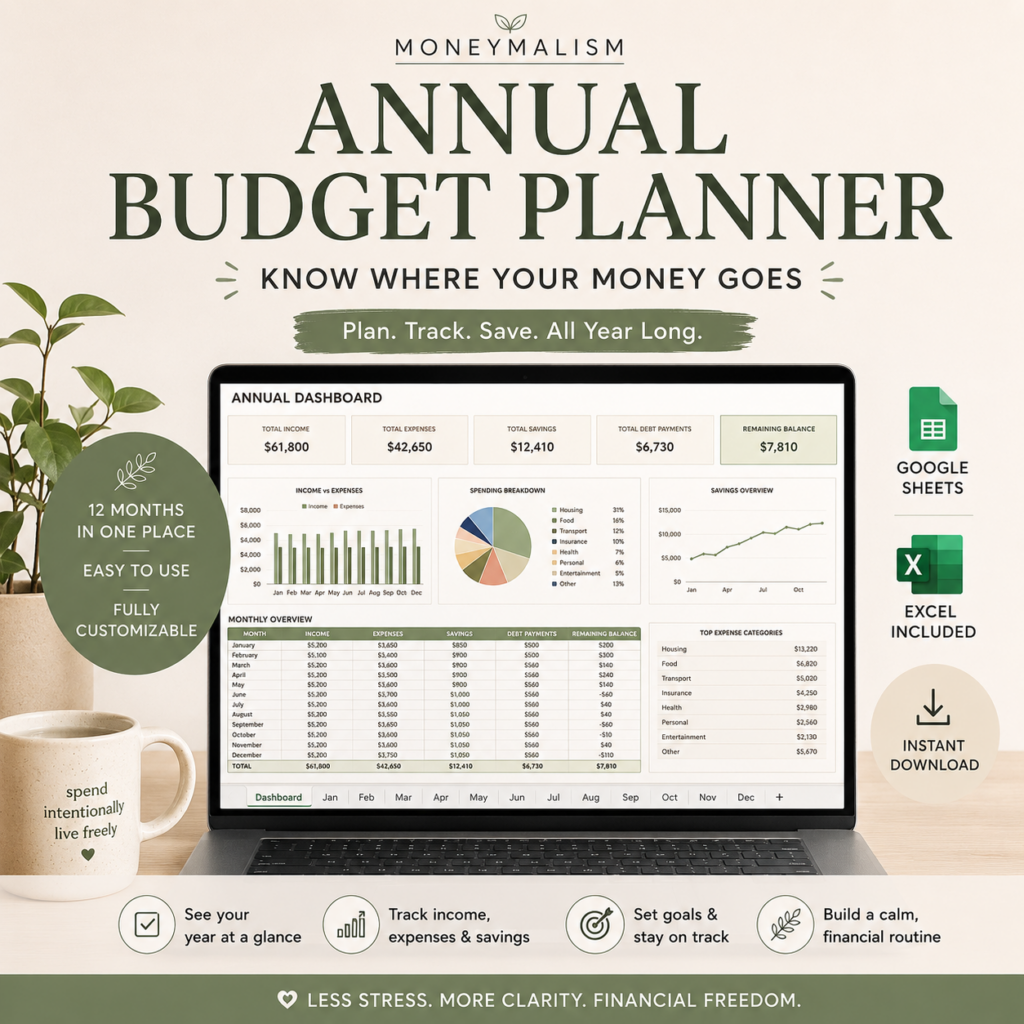
Wanna get your budget under control and start a minimalist life? Then check out my Annual / Monthly Budget Planner Spreadsheet!
The three questions that change everything
Once I start going through a space, I run every single item through three questions. They’re simple, but the effect they have is surprisingly powerful.
Does this item have a current function in my real life? Not in my past life. Not in a future version of myself I’m vaguely hoping to become. Not in a “maybe someday” scenario. In my actual life, right now, today. If the answer is no, the item immediately loses priority. Because keeping things without a current function is essentially paying mental and physical rent for something that gives nothing back — and over time, that cost adds up in ways you feel even when you can’t name them.
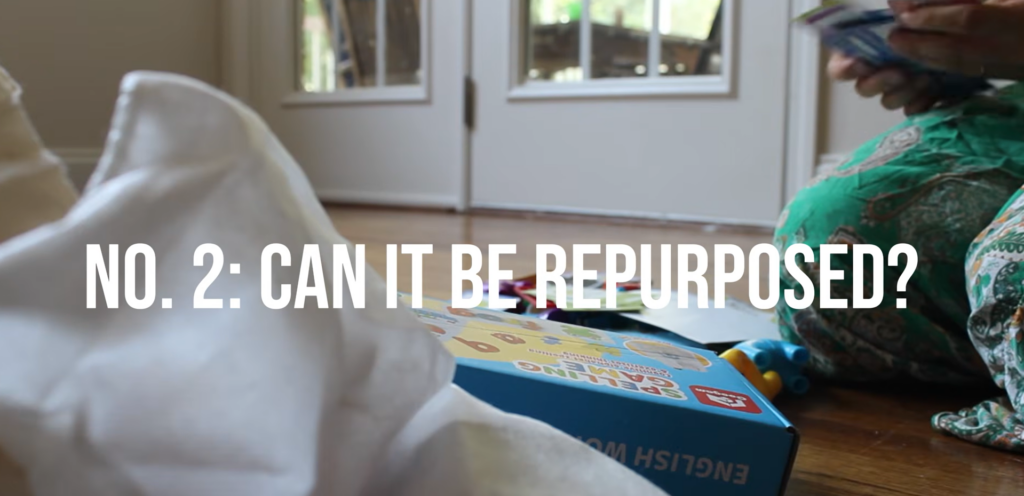
Can this item be repurposed? Before anything goes to the donation box or the trash, I always ask whether it has a second life available to it. A container without a lid becomes a desk organizer. Old fabric that’s too worn to donate becomes cleaning cloths. An item with a different purpose than originally intended can be surprisingly useful. But — and this is a trap I’ve fallen into more than once — repurposing can very easily slide into procrastination dressed up as resourcefulness. So anything waiting for a new purpose gets its own separate box, and it stays there for a maximum of three months. If it hasn’t found its second life by then, the idea wasn’t actually important enough to hold onto, and it can go.
Does this item make my life easier, more functional, or more efficient? This is the final filter, and it’s the one that really gets to the heart of the German Method. Even if something technically has a function, it still might not be useful in your current life, in your current home, at this particular stage. The goal was never minimalism for minimalism’s sake — emptiness is not the point, and comfort is absolutely allowed. A cozy sofa with throw pillows and a blanket one hundred percent belongs in a functional home. But items that don’t genuinely improve your daily life in any meaningful way can usually go, and when they do, you’re not losing something. You’re creating space — physically, visually, and mentally.
Letting go without the guilt
One of the hardest parts of the whole process is dealing with the guilt that shows up so reliably when you’re deciding what to let go of. I spent money on this. I might need it later. My grandmother gave this to me. I should keep it just in case. These thoughts are so normal, and I want to be clear that feeling them doesn’t mean you’re doing it wrong. It just means you’re human.
But here’s the truth that I keep coming back to: if an item no longer fits your life, keeping it doesn’t bring the money back. It doesn’t honor the gift or the person who gave it. It doesn’t protect you from some future need that may or may not arrive. It just keeps the object in your space without purpose, collecting both physical dust and mental weight.
That’s why I find donation so powerful — not just practically, but psychologically. Because it reframes the entire experience. Instead of losing something, you’re returning it to usefulness somewhere else, for someone who will actually use it, who might genuinely need it. That shift in perspective makes letting go so much easier, and over time, it starts to feel less like deprivation and more like generosity.
Keeping it that way: the monthly no-buy experiment
Decluttering is only half the equation. The part nobody talks about enough is what happens afterward — because clutter has a way of creeping back in if you don’t change the habits that created it. And the most effective thing I’ve found for that is a monthly no-buy experiment.
The rules are simple: pick one category — clothing, kitchen tools, books, beauty products, home decor, whatever feels most relevant to your own patterns — and commit to not buying anything new in that category until you’ve used everything you already own in it at least once. Really used it. Not just noticed it exists.
It sounds like a small thing, but it rewires something in how you think about consumption. Suddenly you’re looking at your closet or your bookshelf or your kitchen cabinet with completely different eyes. You start noticing what’s actually there instead of looking past it toward what’s missing. You realize you already have more than you thought. You start using what you own more intentionally, more creatively, more gratefully. And that feeling of enough — which is so hard to manufacture any other way — starts to settle in naturally.
27 items later
Today I decluttered 27 items. On paper, that might not sound particularly impressive. But the number was never really the point. What actually changes isn’t measurable in items — it’s the feeling afterward. The quiet. The mental space that opens up when you’re not being visually interrupted every time you walk through a room. Every item you remove is one less thing your brain has to process in the background, one less micro-decision, one less low-level source of noise. And slowly, steadily, the static starts to fade.
Not dramatically. Not overnight. But noticeably.
A home that supports your mind
Decluttering was never supposed to be about creating an Instagram-worthy home with white walls and empty surfaces and a life that photographs beautifully. It’s about something much more personal and much more practical than that — creating a space that supports your actual life instead of distracting from it. A space that feels calm enough for your nervous system to actually rest. A space that reflects who you are right now, not who you used to be or who you think you should become.
And you don’t have to do it all at once. You don’t have to overhaul every room in a weekend or follow a perfect system or get it right on the first try. You just need to start somewhere. One box. One drawer. One small decision that you actually follow through on. And from there, everything else gets a little bit easier — because you’ve already proven to yourself that you can do it.
Take a breath. Create space. Let your mind rest. 🌿
Let´s make a short break here! 🔥 Are you ready to simplify your life and take control of your money?
Download my FREE 5-Page MoneyMalism Planner Bundle (usually 49,99€!) now – designed to help you declutter your mind, organize your finances, and move boldly towards financial freedom.
✨ Minimal effort. Maximum clarity.
👉 Grab your free planners here!
moneymalism.de – Become a moneymalist. Explore real freedom.